General contracting

General contractor software that tracks every trade, every cost.

Multi-trade job scheduling, subcontractor management, real-time job costing, progress billing, and bidirectional QuickBooks sync. CrewHub360 keeps your projects on schedule and your books accurate without the spreadsheet juggling.

General contractors coordinating multiple trades

Residential remodels, commercial tenant improvements, multi-phase builds, and specialty subcontractor coordination. Whether you self-perform or sub everything out, CrewHub360 tracks who's on site, what it costs, and how close you are to your estimate — in real time.

Residential remodel Commercial TI Sub-managed projects

Multi-trade scheduling across the job

A single job can span weeks and a dozen trades. CrewHub360 structures each job as a sequence of visits — one per trade, per phase — each with its own crew assignment, skill requirements, checklist, and completion status. The dispatch board filters by trade or skill so you always see what's scheduled, what's active, and what's overdue.

  • Multiple visits per job — one per trade or phase
  • Skill-based assignment ensures the right crew per trade
  • Visit status: scheduled → en route → on-site → complete
  • Dispatch board filterable by trade, skill, or crew member
A schedule with every trade laid out across the week
Every trade on one schedule

Subcontractor and vendor management

Subcontractors live in the vendor register as a distinct type. Assign them to job visits, track their invoices and expenses against the job, and pull 1099 totals at year-end without digging through spreadsheets. Purchase orders to subs are linked to the job for full cost visibility in one place.

  • Subcontractors tracked separately from suppliers in the vendor register
  • Sub assignments linked to specific job visits
  • Sub expenses and invoices tracked against the job
  • 1099 records generated at year-end from tracked payments
Subcontractor list with insurance, license, and W-9 status
Subs, insurance, W-9s & 1099s tracked

Job costing: estimated vs. actual in real time

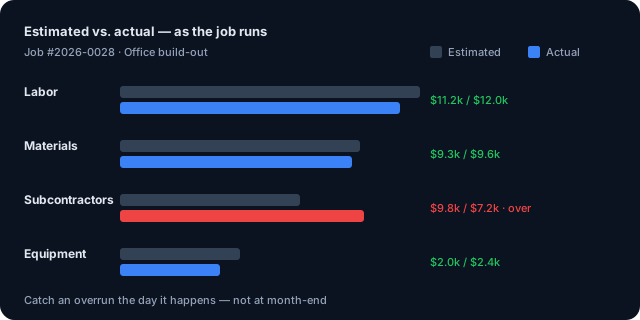
Know your margin before the project closes — not after. Job costing compares your original estimate against actual labor from time entries, materials from inventory transactions and purchase orders, and subcontractor expenses. The job detail screen shows the running total so you can catch overruns while there's still time to act.

  • Estimated vs. actual labor — pulled from time entries automatically
  • Material costs from inventory transactions and POs
  • Subcontractor expenses tracked against the job budget
  • Running cost summary on the job detail screen
Estimated versus actual job costs by category, flagging overruns

QuickBooks sync for progress billing

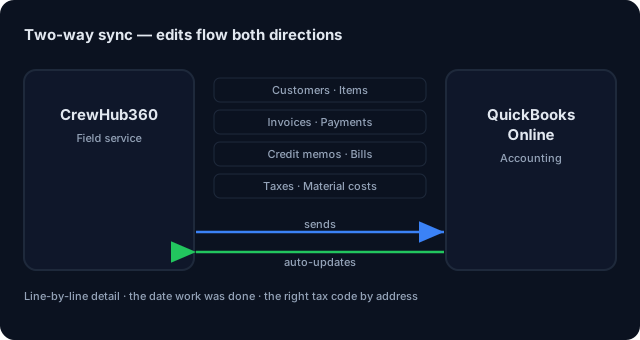
Bill at every milestone — deposit, rough-in, completion, or any split that fits your contract. Each invoice links to the job, goes out via the client portal with a pay-online link, and syncs to QuickBooks the moment payment clears. Bidirectional sync means your books stay accurate without anyone touching QBO manually.

  • Milestone invoices at any stage — deposit to final
  • Pay-online portal link in every invoice email
  • Bidirectional QBO sync: customers, invoices, payments, bills
  • Material cost entries created automatically for materials used
Two-way QuickBooks Online sync of invoices, payments and more

For general contractors

General contractor software: common questions

Can I manage subcontractors in CrewHub360?

Yes. Subcontractors are tracked in the vendor register as a distinct vendor type. You can assign them to jobs, track their expenses, and generate 1099 records at year-end.

How does multi-trade scheduling work?

Jobs can have multiple visits — one per trade, each with its own crew assignment, checklist, and status. The dispatch board shows all active visits across all jobs, filterable by trade or skill.

Can I track project costs vs. estimates?

Yes. Job costing compares estimated vs. actual labor (from time entries), materials (from inventory transactions and purchase orders), and subcontractor expenses — all on the job detail screen.

How does invoicing work for progress billing?

Create invoices at any project milestone — deposit, mid-point, completion. Each invoice links to the job and syncs to QuickBooks. The client pays via the portal link; payments post to QBO automatically.

Does CrewHub360 sync with QuickBooks?

Yes. Two-way sync: customers, service items, invoices, payments, credit memos, and bills all sync. Tax codes pull from the service address jurisdiction. Material cost entries are created for materials used.

Try general contractor management software for 14 days

Free trial. No credit card. Multi-trade scheduling, job costing, and QBO sync ready on day one.

Start Your Free Trial